The new Labour government in the UK predictably ordered a new defence review. Excitable national media journalists soon wrote that the Global Combat Air Programme (GCAP) aka Tempest might be scrapped, citing comments by the Prime Minster and the Armed Forces Minister. Actually they said nothing of the sort, but as I wrote previously here, it certainly should be reviewed – and delayed.
As far as I can tell, the RUSI air power analyst Justin Bronk and myself are the only serious commentators who have expressed any doubt about the Tempest ambition and timescale. That is until late July, when a senior official at Eurofighter[i] wrote to The Times newspaper to say that uncrewed combat aircraft (UCAVs) were the future. Bronk has expressed a similar opinion, to which he recently added that the threat from Russia was now so great that all available defence resources over the next few years should be allocated to operational readiness…weapons stockpiles, spare parts, and so on.[ii] The MoD admitted recently that the UK could not fight Russia for more than two months.[iii]
I don’t rule out another manned combat aircraft like Tempest, but I do agree that it is not a priority. Certainly not when the MoD’s equipment programme is nearly £17 billion unfunded, yet it proposes to spend £12.6 billion on Tempest over the next nine years.[iv] When the UK has no defence against long-range ballistic missiles. When the cost of replacing its strategic nuclear deterrent is growing, yet ring-fenced. When the new government says that better accommodation for the armed forces is a priority. Etc, etc, etc.
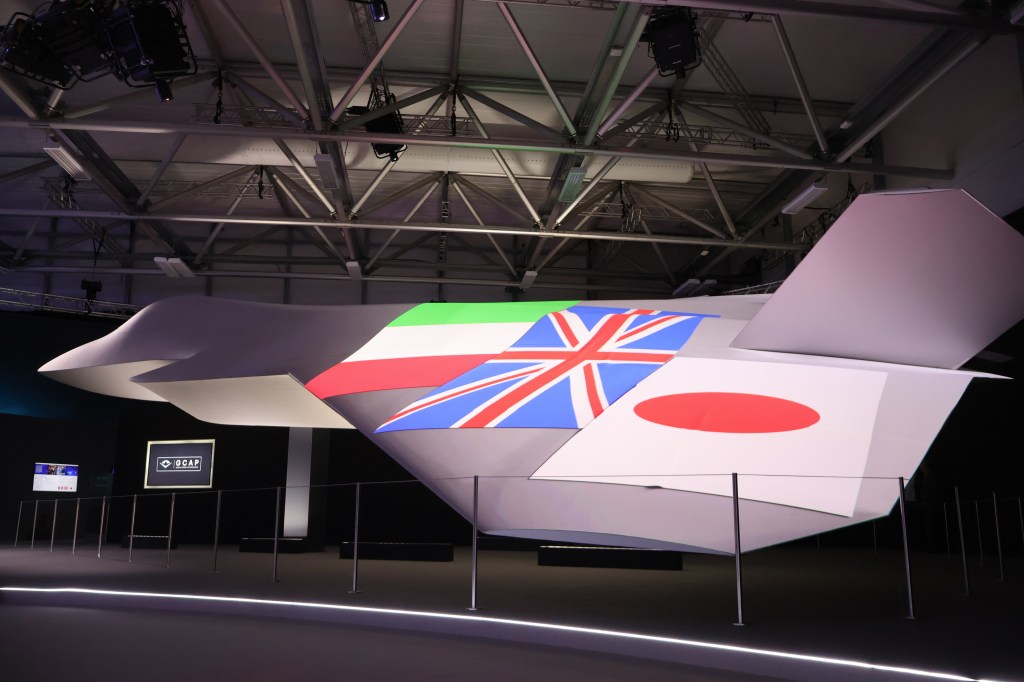
Since I last wrote about the GCAP, the flags of its three international partners have been wrapped even tighter around it. The nations signed a treaty to establish a management organization, and the three main potential contractors (BAE Systems, Leonardo, and Mitsubishi) declared their intent to soon form an industrial consortium. A new justification for the in-service date of 2035 has been added: the Japanese must have it then to replace their F-2s (a uniquely enlarged version of the F-16). Saudi Arabia wants to be “an equal partner”. Will the existing three partners have the courage to tell them that this would only disrupt the management structures already agreed, and the planning for workshare? An effort which, by the way, has already been mostly paid for by taxpayers, as part of the concept and assessment phase that has cost the UK alone £2 billion.[v]
In my last post, I complained that the main contractors and the nations were saying almost nothing about the wider Future Combat Air System (FCAS), of which Tempest is supposed to be a part. Since then, the Royal Air Force has published its “Autonomous Collaborative Platform Strategy”[vi]. It defines ACPs as “a series of uncrewed vehicles which demonstrate autonomous behavior and are able to operate in a collaborative manner with other assets.” The ambition is to have them “routinely operating with crewed platforms by 2030.” This validates my argument that a FCAS doesn’t have to wait for Tempest. The RAF has Typhoons and F-35s available now for that purpose. The UK also has (or soon will have) other FCAS enablers such as the E-7 AEW aircraft, Protector UAV, and naval air defence destroyers.
Indeed, the ACP document comments that “lengthy development-delivery platforms can diminish the strategic relevance of air vehicles.” That sounds rather like Tempest to me: ten years from signing a development contract to getting rubber on the ramp.
It’s quite a contrast. The ACP strategy calls for “an order of magnitude lower cost per vehicle compared to traditional crewed platforms.” The vehicles would be able to operate from land and sea as well as air. They would be provided mostly by innovative British SMEs.
Of course, the RAF could not have written this document without acknowledging its Tempest ambition. But the only reference to it is buried on page 8 where it calls for “seamless interaction (of ACPs) with the GCAP and associated adjunct programme.” Er, what adjunct programme? Not the same thing as ACPs, apparently. There’s hardly been a word about this from the GCAP partners.
At Farnborough, BAE Systems unveiled a full-scale model of Tempest in its latest shape. It is very big – about 65 feet long with a wingspan of 51 feet. At this size, it had better be as stealthy and survivable as advertised, since it will otherwise present a large target to air defence systems. A video showed a weapons bay large enough to carry eight SPEAR air-to-ground missiles plus four Meteor air-to-air missiles. One source told me the weapons bay might actually be even larger.
Three days later, Eurofighter, BAE Systems and Leonardo briefed on upgrades to the four-nation combat jet. They talked of the new radar, new weapons, sovereign supply lines, improved defensive system, more digitisation, more communications, better infrared search-and-track system, and so on. The Eurofighter ceo said that the jet’s operational life could extend to 2060. BAE Systems said the out-of-service date for the UK’s Typhoons was currently 2040. I think that’s actually a justification for advancing Tempest. But given the above-mentioned upgrades to the Typhoons, and their cost to taxpayers, what’s the hurry to replace them?
Meanwhile, the UK has still not ordered a second tranche of F-35s, taking the total buy from 48 to 74 and allowing creation of a third operational squadron. Remember, the RAF was supposed to get 130 of them? The F-35 has its problems, and progress in introducing it in the UK has been slow. Full operational capability is now due by the end of next year. That third squadron may not be in service before 2033.[vii]
Funding for the second F-35 tranche is supposedly ring-fenced, although it makes sense for the UK to withhold any more orders until the Tech Refresh 3 core processor and new displays are proven, and the Block 4 upgrade defined and available. But I still believe the UK should consider ordering a third tranche of F-35s at the end of this decade, this time A-models which are not carrier-capable, but have greater range and lower unit and sustainment costs, bringing the total fleet to about 96.
Some boosters of Tempest delight in bad-mouthing the “fifth generation” F-35. It helps sell their favoured “sixth-generation” fighter to the government. Even the contractors are not immune. At Farnborough, Leonardo displayed the innovation and deep integration of the Integrated Sensing and Non-Kinetic Effects and Integrated Communications Systems (ISANKE & ICS – what a mouthful! Can’t they devise a proper name for this?). An interactive light table showed various combat scenarios. The F-35 was included, but the presenter assumed that in the next decade, the F-35 would have reduced survivability against an integrated air defence system. This seems to me like an attempt to further justify the early introduction of Tempest.
According to Lockheed Martin, the F-35 provides 20,000 jobs in 800 UK companies. Over the next decade at least, Tempest won’t be providing the only boost to high-tech military aerospace jobs. Ironically, one of the main beneficiaries of the F-35 programme is BAE Systems, which makes all the rear fuselages.
In summary, I still believe that the development contract that the GCAP partners want signed as soon as possible should be delayed, for about five years. In the meantime, the UK should complete the Crewed Combat Aircraft Demonstrator that BAE Systems is building, and the Leonardo Excaliber missions systems testbed. Keep funding the demonstrator engine that Rolls-Royce and IHI are building. Perhaps also build a UCAV demonstrator that builds on experience with the BAE Systems Taranis programme in the last decade, which cost the UK taxpayer at least £185 million. Re-allocate some of the bright young engineers that BAE Systems has recruited to the 25 other high-tech projects that the company has underway.[viii] Gain manufacturing and operational experience with the ACPs. Order at least 26 more F-35s. Above all, spend precious defence procurement funds on stockpiles, supply chains, and an integrated air and missile defence.
[i] Dr Andrew Hartland, head of management support, Eurofighter GmbH, 30 July 2024
[ii] comments to the Global Air & Space Chiefs Conference in London, 17th July 2024
[iii] Lt Gen Sir Rob Magowan KCB CBE, Deputy Chief of the Defence Staff (Military Capability), to House of Commons Defence Committee,26th March 2024
[iv] Government Major Projects Portfolio Data for MoD, 2022-23. The GCAP industrial consortium has not yet said anything in public about costs.
[v] Minister for Defence Procurement James Cartlidge to the House of Commons Defence Committee, 21 February 2024. Indistry has spent between £600 million and £800 million.
[vi] This is the RAF term for what are now known as Collaborative Combat Aircraft (CCAs) in the US. The term “loyal wingman” has fallen out of favour.
[vii] Minister for Defence Procurement James Cartlidge etter to the House of Commons Defence Committee, 8March 2024
[viii] See the company’s “Innovators” booklet, new edition 2024.
 Chris Pocock Makes Aerosense
What about cyber and space. Given recent glitches that brought half the world to a standstill I think apart from the nuclear deterrent this should be a major issue for the upcoming defence review. Yes we need something to follow on from Typhoon and F-35 but lets lock the doors first before we start looking outside.
LikeLike