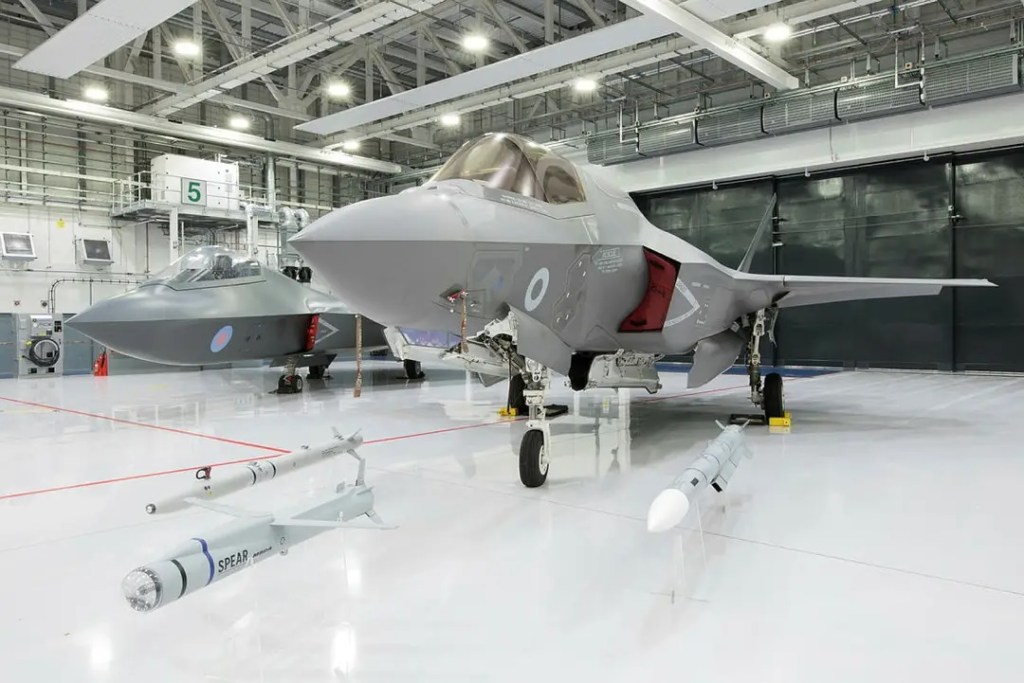
One of the most interesting aspects of the UK’s Strategic Defence Review (SDR), which finally surfaced earlier this week, was the suggestion that the UK should invest “in the range of capabilities necessary to deter nuclear use at any scale.” The review also stated that “more F-35s will be required over the next decade. This could comprise a mix of F-35A and B models.”
The implied suggestion that the MOD should consider re-introducing tactical nuclear weapons has been prompted by the need to deter Russia, which has threatened to use such weapons over the Ukraine conflict. The UK has not had a sub-strategic nuclear deterrent since the air-delivered WE177 bomb was retired in 1998.
One day before the SDR surfaced, an unsourced story in The Sunday Times reported that the UK was exploring with the US, the addition of an American nuclear bomb to the UK’s F-35s. This story was not validated by an explicit recommendation to that effect in the SDR. But still, that is the implication, unless we are going to build our own new air-launched nuclear weapon.
(Incidentally there were a number of pre-publication leaks by government politicians and officials to the national media around the publication of the SDR. That is the way of the world today – it’s called media management. But pompous parliamentarians were furious that they didn’t get first sight of the document.)
Some years ago, the MOD set aside the funds to procure another 26 F-35Bs, bringing the total to 74. But the order has not yet been placed. If the stealthy jet was to take on a nuclear role for the UK, the UK would have to buy land-based F-35A versions instead. The B61-2 nuclear bomb was certified in October 2023 for the F-35A – only.
In fact, there are other good reasons for operating the F-35A variant, as I have explained before on this website. The Royal Navy would scream and shout, since they want more STOVL F-35B versions to go on their two carriers. However, the SDR strongly emphasizes a “NATO First” strategy, which it describes as “a different approach from that taken since the end of the Cold War.” There is no mention of the “expeditionary” strategy that drove the acquisition of the carriers in the first place. I think they should be confined to European and North Atlantic waters in support of NATO – in which case, the 48 F-35Bs already ordered and mostly now delivered, would probably be enough.
However, putting American nukes on British F-35s would not result in an independent deterrent, which is what we in the UK supposedly have with the Trident nuclear submarines. The US would retain control of these bombs, just as it does today with the older B61s that are stored in five NATO nations. They would be loaded, flown and dropped by F-16s and Tornados operated by those countries, if required, God forbid. Or would they? I have never understood how this scheme works. Would those host countries really take responsibility for such an escalation?
If we want a truly independent air-launched tactical nuclear deterrent, we should employ sovereign warheads, just as the French do with Rafales that can carry the ASMP nuclear cruise missile. Which has much longer range than the B61 gravity bomb.
More generally, the progress of the F-35 has been exercising me recently. I haven’t properly reviewed developments with the massive Lightning II enterprise since I last wrote about it in Aviation International News six years ago. So I’ve been taking another look. The story is rather depressing.
Quite apart from the well-publicised fleet-wide problems over serviceability, sustainment, operating costs, the F135 engine, and technical upgrades, there are particular issues surrounding the UK’s operation of the fifth-generation stealth fighter. Especially the integration of two new British weapons – the long-range Meteor air-to-air missile and the SPEAR-3 air-to-surface missile.
I was stunned to read a parliamentary answer last month by the government’s defence procurement minister on when the SPEAR-3 would be in service on our F-35Bs. Not until the “early 2030s”, she said. Even that date is tentative, since the weapon “is currently undergoing re-baselining…dates are considered draft and of low confidence.”
Now this is a weapon that has been funded by the British taxpayer since about 2012, when the assessment phase started. Development began in 2016 and was supposed to last four years. I wrote a detailed story about it on this website in 2019. I explained that it was a very complex missile precisely because of the need to provide “Selected Precision Effects At Range” – hence the acronym SPEAR. Even so, for a likely 20 years to pass from concept to capability, is remarkable. Meanwhile, the spend on this missile has ballooned to a predicted £550 million by 2027.
MBDA, the maker of SPEAR-3, is not entirely to blame. Lockheed Martin must shoulder some (most?) of it, for the protracted and costly F-35 integration delays. The same is true of the Meteor, also produced by MBDA. This was another near 20-year development, starting with the assessment phase in 1997, but at least it is now in service on the Eurofighter, Rafale and Gripen.
But not on the UK’s F-35Bs. Work to integrate both Meteor and SPEAR-3 on the stealth jet began in 2019. An MBDA director said in September 2021 that “work continues at pace to deliver Meteor and SPEAR capability to the F-35”. In January 2024 the MOD told Parliament that the weapons would be integrated “by the end of the decade”.
The delays are part of a wider problem with avionics and hardware upgrades to the F-35 First, there is the “Technical Refresh 3” (TR-3). It comprises a new core processor, extra memory, a radar upgrade and new cockpit displays, all designed to an open systems architecture. There has been a near two-year delay in fielding it on new-production F-35s.
After TR-3 comes a further upgrade to produce Block 4 aircraft with new sensors and weapons, and an improved F135 engine with increased thrust, lower unit and sustainment costs, and a much more effective system for power supply and thermal management. The latter has been a big problem on the F-35 ever since it entered service. But Block 4 won’t be ready until the end of this decade.
The MOD confirmed recently that it “intends to upgrade the UK F-35B fleet with Block 4 modifications.” This begs a number of questions: when? can the jets already delivered actually be modified? if so, how much will it cost? OEMs like Lockheed Martin make a lot of money out of integration and modification. In 2021, the MOD said that the cost of adding ASRAAM and Paveway IV – the F-35B’s existing weapons – would be £150 million. and SPEAR another £170 million.
So what should the MOD do? It has been wise to delay committing to a new batch of jets, until the TR-3 upgrade and some of the issues mentioned above are ironed out and proved in USAF service. But when it does actually get airborne, the F-35 has performed very well, and its low-observability has been proved. Six European countries have ordered it since 2022, despite being aware (presumably) of the problems outlined above. The unit production cost has reduced over recent years to no more than fourth-generation combat jets such as the Eurofighter and Rafale. The UK defence industry provides a significant number of subassemblies and subsystems for every F-35.
So I still think the UK should buy another two batches of 24 jets each, and my opinion has seemingly been backed by the SDR. I believe that they should all be A-models, with greater range and weapons-carrying capability than the F-35B, plus a lower acquisition and operating cost. They will precede the tri-nation Tempest/GCAP sixth-generation fighter, and supplement it in the 2040s.
Incidentally, although the GCAP was endorsed in the SDR, Chapter 7.4 on air capability seemed more enthusiastic about Autonomous Collaborative Platforms (ACPs) as part of a wider Future Air Combat System (FCAS). Quite rightly, in my opinion.
 Chris Pocock Makes Aerosense