There was plenty of media coverage of this year’s show, which I will not duplicate here. Instead, I will comment on some of the less obvious aspects of the event, based on my long experience of working at previous shows, and my regular visits to Singapore that go back nearly 50 years.
Much of the show seemed familiar, especially the flying display. But the stands offered plenty for official delegations, trade visitors, plus journalists and commentators such as myself. Show organisers Experia claimed that over 65,000 people from 130 countries visited on the trade days.
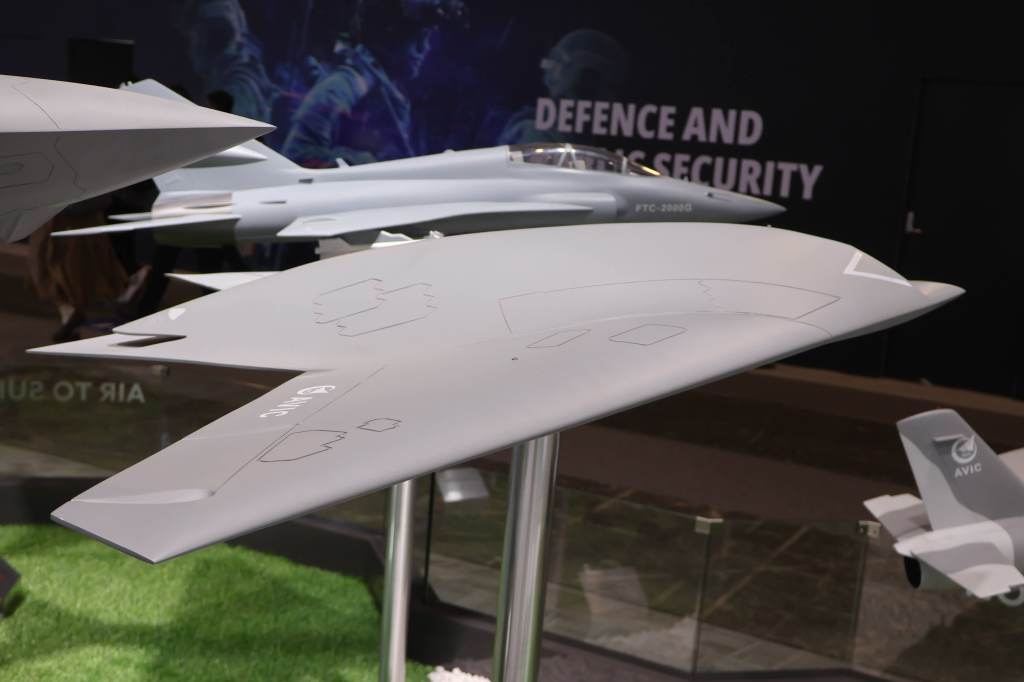
The Chinese stands got plenty of attention, including a ridiculous stunt staged for social media by the boss of Anduril, the fast-expanding drone and AI start-up. He was shown measuring the dimensions of the half-scale model of the J-35 fighter on the AVIC stand. I could have told him that the real thing has appeared at previous airshows, and its dimensions are already public knowledge.
The AVIC stand featured the usual large collection of scale models, mostly 1/10th. The ones that caught my attention were a large unmanned, armed helicopter labelled X-2000, the GJ-11 UCAV, a new version of the Wing Loong MALE UAS, and a tandem-seat turboprop trainer.
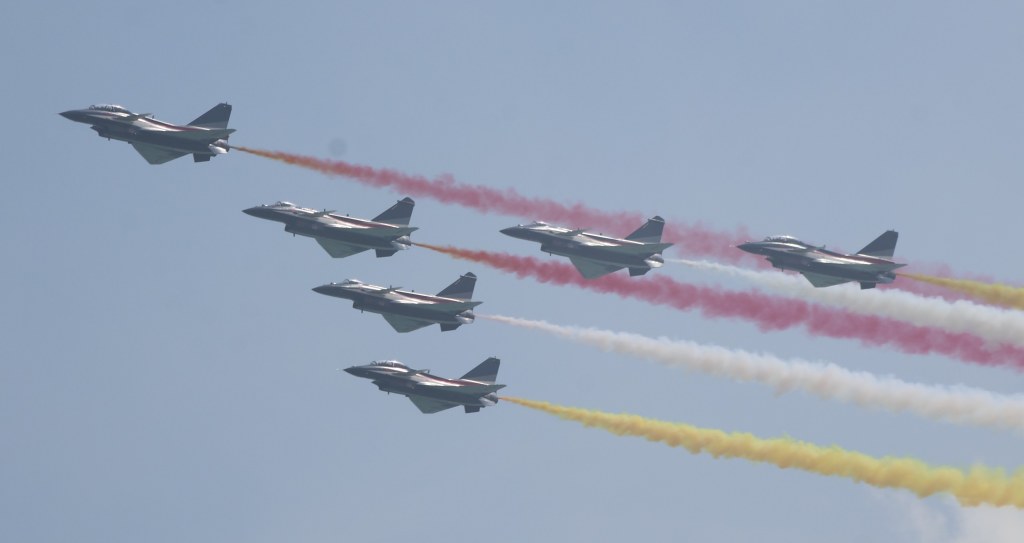
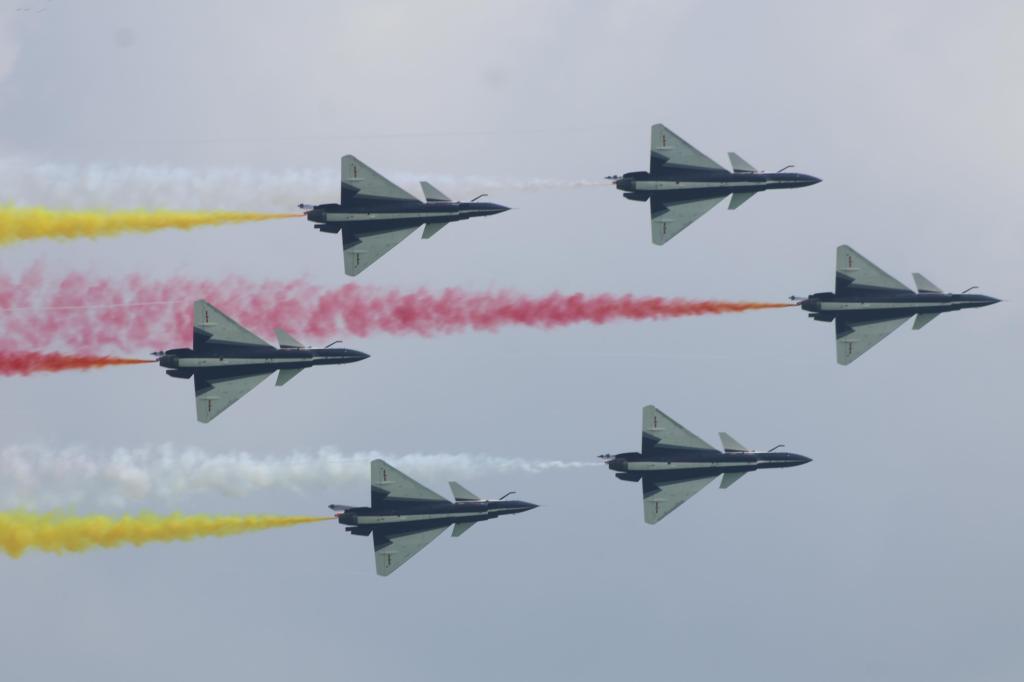
The highlight of the flying display was the Ba Yi (August 1st) jet aerobatic team of China’s PLAAF, with their six J-10 combat aircraft. At their last appearance here in 2020, the team was still flying the original J-10A version. Now it is equipped with the J-10C, a seriously-upgraded version, including a diverterless intake, more powerful domestic WS-10 turbofan and an AESA radar. What a pity that they did not put one on static display! Were they worried about Western spies? That would be ironic, considering the amount of aerospace technology that the PRC has stolen from the West through espionage over the years.
Strangely for such a prominent and publicity-conscious company, staff on the Anduril stand were reluctant to talk to me about its many notable developments and prospects. Especially since they are now in a partnership with the Republic of Singapore Air Force (RSAF) and the Singapore government’s Defence Science and Technology Agency (DSTA) to explore Manned-Unmanned Teaming (MUM-T) concepts.
The DSTA also recently explored MUM-T with Airbus Helicopters, flying some trials with an Airbus Flexrotor UAS linked to an RSAF H225M helicopter. And that is not the only leading-edge technology partnership between Airbus and Singapore. Together with the DSTA and the RSAF, Airbus has now completed certification of an automatic refueling technique for the A330MRTT.
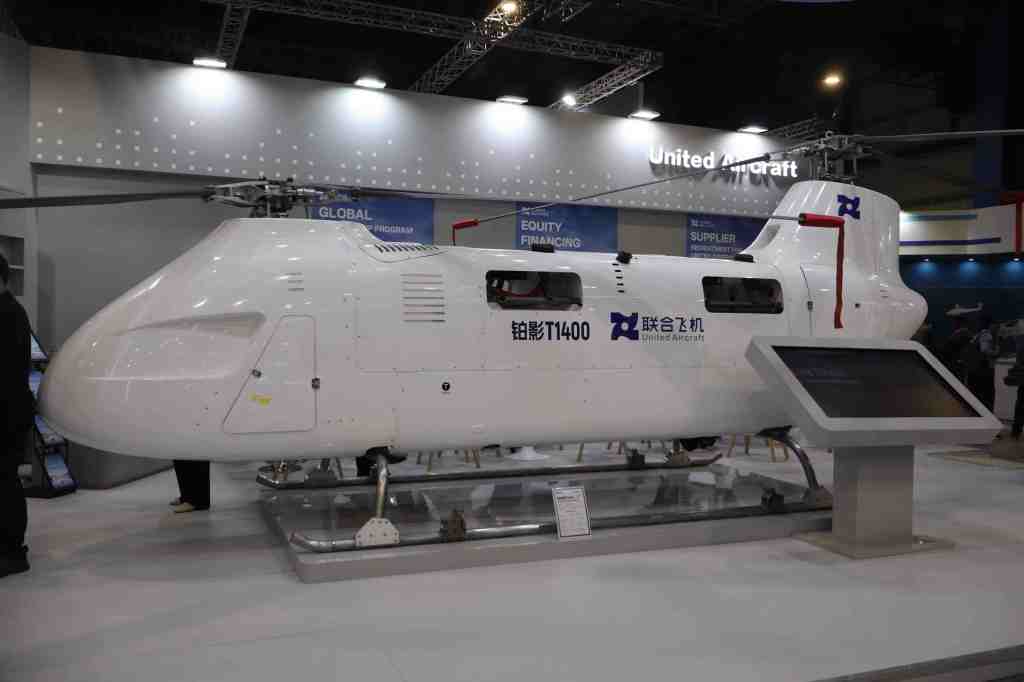
At the United Aircraft stand, I saw much deferential bowing by staff, when a high-level delegation from the PLA stopped by. As at previous shows, this group displayed interesting UAS developments. The stand was dominated by a full-scale model of a large tandem rotor unmanned heavy-lift helicopter designated T1400. It is 6.6 metres long, and can fly for 200km with a payload of 650kg (including fuel).
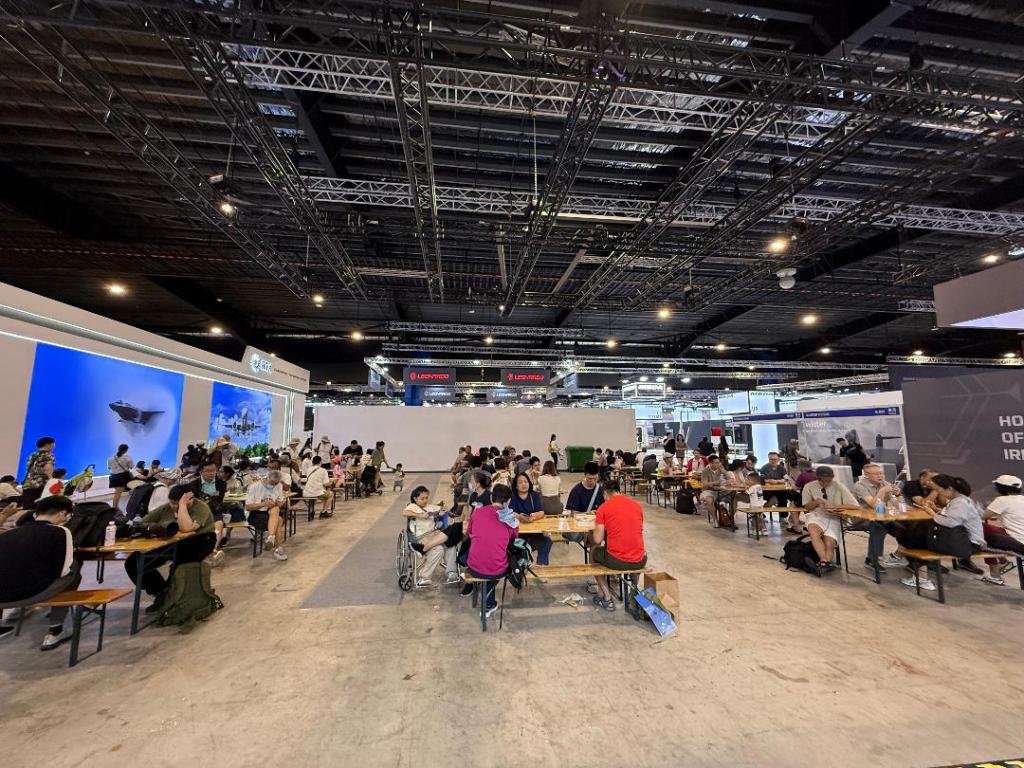
Israel Aircraft Industries (IAI), Elbit Systems, Rafael and Orbiter all took stands, as usual. There was a discreet police presence around them, for fear of pro-Gaza demonstrations. The war is a sensitive issue in Singapore, with its significant Muslim minority population. Demonstrations of any kind are frowned upon here. But just in case, the Israeli stands were dismantled on Friday night and the areas converted with tables and chairs for the public showgoers on Saturday and Sunday.
I do like covering off-beat developments in aerospace. Two of these were on display: the ST Engineering AirFish Wing-In Ground effect (WIG) craft, and the Radia Windrunner. There has been progress with the former since I reported on it two years ago for AIN Singapore Airshow News. But the latter doesn’t seem much closer to launch since I wrote about it for AEROSPACE magazine in December 2024. I’ll be posting separate stories on both ventures on this site shortly.
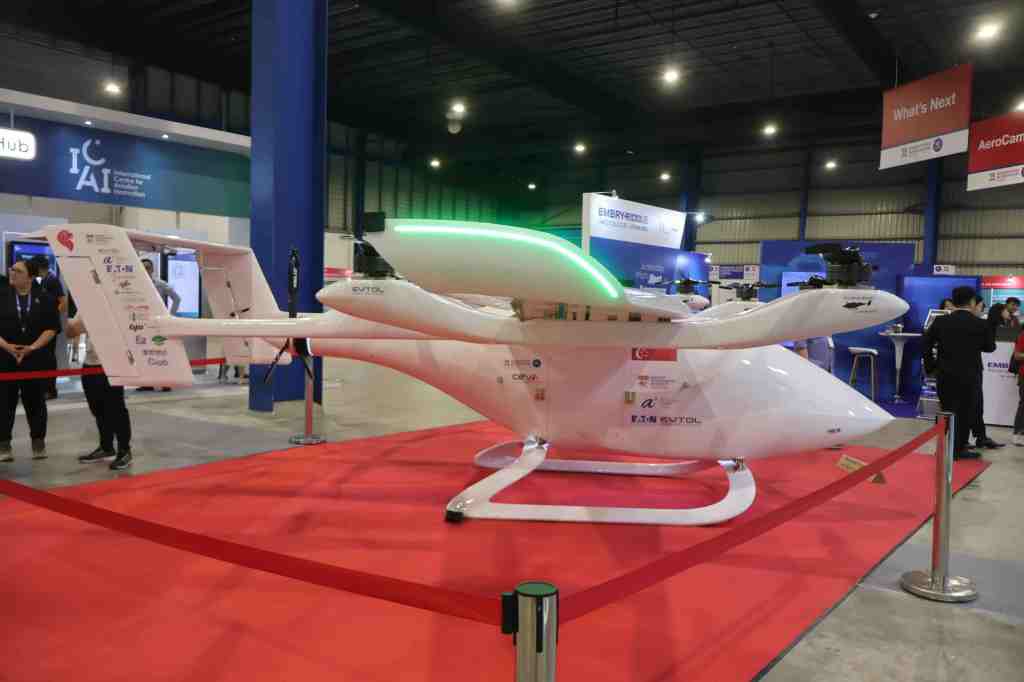
There were plenty of urban mobility proposals on display. This is not a particular interest of mine, but I was surprised to see a real eVTOL aircraft, albeit 1/6th scale, on the stand of Nanyang Technological University. I thought this was just a student project until I learned that it is a serious attempt to produce a home-grown, four-passenger machine. It has been government-funded since 2023. Hover trials started in Singapore recently, although most flight testing will take place in Germany with a second demonstrator.
As ever, Singapore’s ambitions to expand are constrained by the lack of space on what locals fondly call “The Little Red Dot”, because of the island’s small size and red-coloured flag.
Most show visitors reached the site via the long detour along Tanah Merah Coast Road and Aviation Park Road, on a huge area of land that was reclaimed from the sea some years ago. They could see the massive construction works for Changi’s Terminal Five, which is set to open in the early 2030s and offer an additional 50 million passengers annual capacity. Near to the site, large buildings to accommodate a depot for the a new MRT line were apparent.
Not so apparent were the works to create a much-expanded Changi Airbase East, including a fourth runway parallel runway that is being built to accommodate some of the RSAF’s aircraft displaced by the closure of Paya Lebar airbase.
The closure of Paya Lebar, which houses the RSAF’s F-15 and C-130 squadrons, has recently been confirmed for 2030. More of the Air Force’s large fleet will move to an expanded Tengah airbase, which includes a new second runway. Then, a massive new housing estate will be built to accommodate 150,000 of Singapore’s expanding population. The government has accumulated huge experience in urban planning over the years, and the new development will doubtless be a fine example.

ST Engineering’s aerospace business also occupies a large portion of Paya Lebar, including airliner overhauls and freighter conversions, deep-service of the RSAF fleet, plus component and engine overhaul. Some of these activities will move to a large new complex at Changi Creek on the northeastern end of the airport. Construction there is well underway.
The RSAF has ordered 20 F-35s, eight conventional F-35A versions and 12 F-35B STOVL versions. It takes delivery of the first B-models this year, which will remain in the US for training at Ebbing airbase, Fort Smith, AK. It will be another three years before the stealth fighters arrive in Singapore. They will be based at Tengah, but the main reason for buying the STOVL version is to perform dispersed operations. Despite hardening, the island’s remaining air bases look vulnerable to attack.
A reclaimed island south of Jurong Island but still within Singapore’s sovereign waters will be expanded for F-35 STOVL training. The 2,000 metre runway already built at Pulai Sudong by the RSAF for emergency landings will be extended to 3,000 metres. The local aviation website Alert5 has more detail, including a discussion on how the plan will mitigate the effect of the very noisy F-35B STOVL operations on Singapore residents.
Finally, I heard rumours that the arrangements surrounding the show will be reviewed by the government before the next edition in 2028. For instance, only a limited time slot of about an hour is allowed for the flying display, because of disruption to airline schedules. That disruption will only grow as Changi Airport expands. (A second slot is permitted on the public days at the weekend, which attracted 60,000 spectators this time, according to the official estimate.)
In the meantime, I understand that at least one invitee for the flying display declined to participate because of the restrictions. The UAE’s Al Fursan jet aerobatic team wanted to fly every day, but would have been limited to alternate days or similar, as were the other aerobatic teams. Show organisers Experia did not respond to my request to comment on these issues. But it is effectively government-controlled, so I dare say that a solution will be found.
 Chris Pocock Makes Aerosense