After the killing of Al Qaeda leader Ayman al-Zawahiri in Kabul last Sunday, President Biden was quick to proclaim the success of the ‘over the horizon’ method of striking at America’s enemies. It was indeed a great example of co-ordinated action between informants and spies on the ground, and persistent surveillance leading to strike from the air. Satellite imagery and signals intelligence must have also contributed. Known information on the structure of the villa that was struck, was also factored in.
But consider this. Those spies might not always be available, or clever enough, to monitor a terrorist hideout so effectively. The Taliban government is still working to effectively administer major cities in Afghanistan, and might improve its counter-surveillance capabilities in the future. Including the ability to intercept or control suspicious communications from the spies, which must have played a part in facilitating the strike. Also, one wonders whether the up to $25 million bounty that the US offered for the capture of al-Zawahiri was a motivation for this action. Is the US going to offer such bounties to its spies, for lesser terrorist actors? And what about terrorists who cannot be identified by name, even if they are deemed to be planning action?
Then there is the potential vulnerability of the airborne component. The MQ-9 Reaper was apparently able to loiter over Kabul for the extended period needed to establish the ‘pattern of life’ around that villa, to even include Al Zawahiri’s habit of appearing on its balcony. That was only possible because the Taliban have no air defences. How long will that be the case? Mischief makers like China, Iran or North Korea could easily provide the Taliban with a basic ground-to-air capability, with anti-aircraft guns and shoulder-fired missiles, and perhaps followed by some longer-range weapons.
There is also the question of how surveillance of a target by the MQ-9 can be maintained for extended period of time. Yes, the Reaper has great endurance, but it must eventually run short of fuel and return to base. If that base is more than a thousand miles away, an MQ-9 could take five hours to reach the area of interest at its normal cruising speed.
As for ‘overhead’ intelligence, the capabilities of the US National Reconnaissance Office (NRO) imaging satellites have been described as “exquisite” by insiders. They probably are, in terms of resolution. But they cannot defeat cloud cover that may be present over potential targets. Moreover, I don’t believe that their ‘revisit rates’ are frequent enough to offer an ‘unblinking eye.’
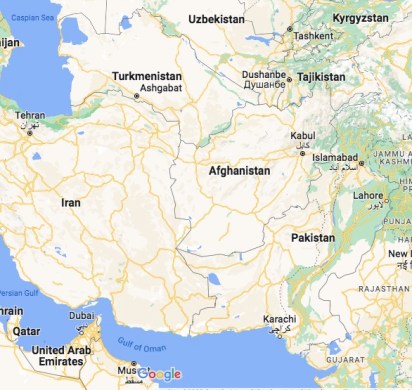
Most observers have assumed that this strike was mounted from an airbase in the Gulf. But I suspect it was mounted from Tajikistan or Uzbekistan. Those countries are no friend of the new regime in Kabul. After the 9-11 attacks, when the US scrambled to counter Al Qaeda’s bases in Afghanistan, the CIA was able to operate armed MQ-1 Predators from Uzbekistan. The transit time was much reduced, but did not come without cost. The Uzbeks imposed various restrictions, in order to keep its participation secret, and these hampered the effective operation of the UAVs. Incidentally, the Reapers involved in the latest action may have been operated by the CIA rather than the US Air Force. The main reason why the CIA has its own fleet of UAVs, is to mount operations that rely on deniability, such as covert flights from secret bases.
So then, if these various constraints preclude the use of the MQ-9 and similarly vulnerable platforms, could not manned combat jets do the mission? The US has plenty of these at airbases in the Gulf, and on aircraft carriers in the region. But if they are to reach Afghanistan unhampered, Iran will deny its airspace, and so they must fly over Pakistan. A fleet of air refueling tankers over the Arabian Sea will be required, for pre- and post-strike top-ups. Moreover, can the US always rely on Pakistan, an unreliable ally with unstable governments? There was plenty of anti-American rhetoric from Prime Minster Imran Khan, before he lost office last April.
Some of the constraints on over-the-horizon targeting that I have mentioned, would also affect strikes against terrorist targets elsewhere. The US National Security Council spokesman John Kirby said yesterday that the terrorist threat extends to North Africa, the Sahel, the Middle East, and Yemen.
Meanwhile, the latest report from the United Nations Assistance Mission in Afghanistan (UNAMA) notes that “there are no recent signs that the Taliban has taken steps to limit the activities of foreign terrorist fighters in the country. On the contrary, terrorist groups enjoy greater freedom there than at any time in recent history.” The jury is still out, on whether the US and its allies can counter Afghan-backed terrorism without committing ‘boots on the ground.’
 Chris Pocock Makes Aerosense
On the SITREP in Africa:
There has been a lot more of threat developing down even so far as in MOZAMBIQUE – heading the way of all the Western Players, albeit their first priority is Infrastructure and Population at first where they are active…
Once they succeed in assimilating or subjugating those, then SOUTH AFRICA and ZIMBABAWE are going to naturally be next on their agenda.
I would expect that SOUTH AFRICA would take priority – as many of the more capable War Hardened Veterans of the former SADF and SAP (Force) COIN Units are still Training the current generation of SANDF and SA Police Service Special Task Force, and are leading many of the SANDF’s most effective COIN efforts in MOZAMBIQUE (Especially true within the SANDF Special Forces – whom have proven more effective in COIN than any other SANDF Units – even the Russian Mercs have failed miserably in countering the African Jihad for their “Revolutionary” Allies, so that they have to now rely on the deminishing numbers of former SANDF and SAP (Force) Veterans and erstwhile enemies of Marxist Revolutions).
The USA and UK would do well to start brainstorming the loss of the old Soviet Allies in Southern and Central Africa to the Jihadis, as Jihadis have proven that they are not Ignorant of abusing Infrastrutcure and Natural Resources to finance and progress their goal of a “Global Single Caliphate” — Imagine what they would do when they have ANGOLA, SOUTH AFRICA, NAMIBIA, CONGO etc. in their grasp (They will then have natural materials essential to create Sophisticated Strategic Nuclear Weapons, and I am certain PAKISTAN or another Quar’anic State “on side”, will at that point provide the Techincal expertise and enlist in joining the Aim of the Qur’an and Hadith’s Global Single Caliphate, if for no other reason to seek to Eradicate the Jews in ISRAEL)…
North Africa was only the natural launching pad in Africa – SOUTH AFRICA has a large Moselm Community – the question is only when does the Aim of a Global Single Caliphate become a reasonable reality within the Short and Medium Term for those whom are devoted followers of Qur’an and Hadith, within any particular community or nation?
If there is seen to be a real and active growing desire to make it happen by Jihad, I should think that there will be a growing expectation and groundswell of support (Whether in Logistics, Finances and in Enlistments (Imagine a Jihadi Islamic State Army suituated in SOUTH AFRICA…).
We all should be concerned to ensure that no such expectation is considered reasonably achievable anywhere – and that means denying resources and ability to create expectations of success.
Africa has proven a hard large cpntinent to seek to bring positive change to for a long time, many would consider it impossible – just ask the African Refugees that have risked all manner of violence to escape to the reasonable stable Western Nations… They know that the most evil and barbaric practices are commmonplace and that it is futile to stay and hope for positive change. Sadly this cretaes a major drain of anyone hoping for peace and prosperity and you end up with Predators and Prey left behind – that means that the Predotrs increase in power and influence.
I would suspect that SOCOM have seen all of this in their reports, I have heard Interviews with US Special Forces Veterans whom speak of their experiences in Africa (*Usually Northern and Central Africa) where they have seen these things happening already – I expect tha the only Reliable Platforms for use in Surveillance in COIN Operations are those that can operate below cloud base (An intersting devolpment in the last decade has been the return of small slow but heavily armed Prop Aircraft with good endurance and good visibility and engines with less noise).
Small Light Attack/Armed Reconnaissance Aircraft are light Small Teams Special Operations, they are flexable and can hit hard and run, in good numbers they can expose and hamper Inusrgency Operations over large areas, but I expect that High Altitude manned Reconnaisance will very much determine their success – as you need to have that level of Co-Ordination that can be provided by Platforms such as The U-2 to make the best and most effective use of such “Hit and Run” tactics, and no other Platform can provide it to Light Attack/Armed Reconnaissance Aircraft and Attack Helicopters and Special Operations Forces that would be able to effect the most successful Raids on Insurgency Forces spread out over large areas in Dense Bush and Forests.
Just my to cents on possibilities in the greatly varying Topography of Africa.
LikeLike